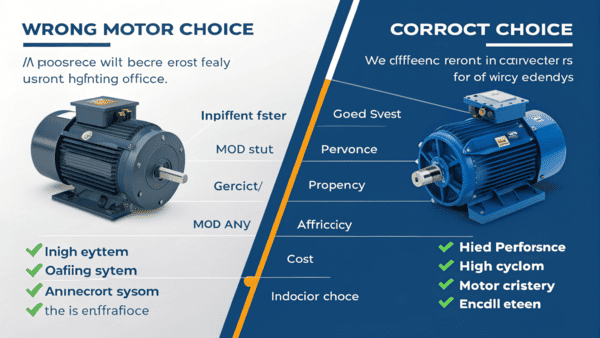
Struggling with high energy bills or frequent equipment failures? An incorrectly sized motor is often the hidden cause. Let's find the right fit for your machine.
To match the perfect motor, you must accurately calculate your load's power (kW/HP) and torque requirements. Then, select a motor frame size that fits your space and a speed (RPM) that matches your application's operational needs. This ensures efficiency and longevity.
I've seen countless cases where a simple motor mismatch caused huge problems for a business. It's a critical decision that impacts your bottom line. In my 38 years in this industry, I've learned that getting the basics of selection right is everything. Let's break down how to do just that, so you can avoid common pitfalls and choose a motor that serves you reliably for years to come.
How Can Precise Motor Matching Boost Efficiency and Lifespan?
Is your motor overheating or underperforming? This "mismatch" wastes energy and shortens its life. A precisely matched motor solves both problems, saving you money and downtime.
Precise matching ensures the motor operates near its peak efficiency point. An oversized motor wastes energy on light loads, while an undersized one overheats and fails prematurely. The right fit maximizes performance, minimizes energy consumption, and extends the motor's operational lifespan significantly.
In the world of motors, we often talk about two costly mistakes: "big horse pulling a small cart" (oversizing) and "small horse pulling a big cart" (undersizing). Both scenarios seem like minor issues, but they have major consequences for your operations. I remember a new client who was proud of using oversized motors on all his conveyor belts, thinking it was a "safer" choice. He was shocked when we did an energy audit and showed him how much he was overspending on electricity due to poor efficiency. The right motor isn't the biggest one you can fit; it's the one that's just right for the job.
The Problem with Oversizing
When you use a motor that is too powerful for its load, it operates far below its optimal efficiency point. It draws more power from the grid than it needs to, leading to a poor power factor and wasted electricity. This is like using a massive truck to deliver a small pizza. It gets the job done, but it's incredibly inefficient and costly. Over time, these energy losses add up to significant, unnecessary operational expenses.
The Dangers of Undersizing
Undersizing is even more dangerous. A motor that is too small for its load will constantly struggle, draw excessive current, and overheat. This thermal stress breaks down the winding insulation, which is the heart of the motor. It leads to a rapid decline in performance and, ultimately, premature failure. The initial savings from buying a smaller motor are quickly erased by the high costs of replacement, labor, and unplanned production downtime.
| Mismatch Type | Primary Issue | Consequence for Your Business |
|---|---|---|
| Oversizing | Poor Efficiency & Power Factor | Higher electricity bills, wasted energy. |
| Undersizing | Overheating & Strain | Frequent breakdowns, costly replacements, production downtime. |
| Precise Match | Optimal Performance | Maximum efficiency, long lifespan, lower total cost of ownership. |
How Do You Determine the Right Motor Power (kW/HP)?
Guessing motor power is a recipe for disaster. It leads to inefficiency or failure. Let's look at a simple, reliable way to calculate the exact power you need.
To determine the right motor power, first calculate the required torque (T) and speed (N) for your load. Use the formula: Power (kW) = (Torque (Nm) x Speed (RPM)) / 9550. Always add a service factor (typically 1.15-1.25) to handle peak loads.
Calculating the right power doesn't have to be complex. It's a foundational step that we help our customers with every day. The goal is to understand the work your machine needs to do. Is it lifting a heavy load, turning a fan, or running a conveyor? Each task requires a specific amount of rotational force (torque) at a certain speed. Once we know those two things, finding the right power is straightforward. We use our 35 years of design experience to ensure these calculations are accurate, because we know a reliable motor starts with a correct specification.
Calculating Your Load Requirements
First, you need to identify the demands of your application.
- Torque (Nm): This is the rotational force needed to do the work. For example, the force required to turn a screw conveyor or pump a viscous fluid.
- Speed (RPM): This is how fast the motor's shaft needs to spin to operate your equipment at the desired rate.
Once you have these values, the formula Power (kW) = (Torque (Nm) x Speed (RPM)) / 9550 gives you the theoretical power needed.
Applying a Service Factor
Machines rarely operate under a perfectly constant load. There are startups, peak demands, and minor fluctuations. The Service Factor (S.F.) is a multiplier that gives the motor a safety margin to handle these intermittent overloads without being damaged. A standard motor might have an S.F. of 1.15, meaning it can handle a 15% overload for short periods.
| Application Type | Typical Load | Recommended Service Factor |
|---|---|---|
| Fans & Centrifugal Pumps | Smooth, predictable | 1.15 |
| Conveyors & Mixers | Moderate shocks | 1.15 - 1.25 |
| Crushers & Reciprocating Pumps | Heavy shocks, hard starts | 1.25 or higher |
Choosing the correct service factor is critical for longevity, a core principle of every motor we build at Gaoqi.
What Role Does Motor Frame Size Play in Selection?
Worried a new motor won't fit your machine? Frame size isn't just about dimensions; it affects mounting and cooling. Choosing the right one is crucial for a smooth installation.
Motor frame size, governed by standards like IEC and NEMA, dictates the motor's physical dimensions, mounting hole patterns, and shaft height. This ensures interchangeability and proper fit. A larger frame size often corresponds to higher power and better heat dissipation.
I once visited a customer in the United States who was frustrated because a replacement motor he bought online wouldn't bolt onto his machine, even though the power rating was correct. The mounting holes were off by just half an inch. He had wasted time and money on a motor he couldn't use. This is why frame size standards are so important. As a company that exports over 50% of our motors to places like the US and Japan, we are experts in both NEMA (North American) and IEC (International) standards. We make sure our customers get a motor that not only performs perfectly but also fits perfectly.
Understanding IEC and NEMA Standards
These standards create a universal language for motor dimensions.
- IEC (International Electrotechnical Commission): Used globally, including Europe and Asia. Frame sizes are metric (e.g., 90L, 112M).
- NEMA (National Electrical Manufacturers Association): Used primarily in North America. Frame sizes are imperial (e.g., 56, 145T).
A frame size designation tells you everything you need to know for installation.
| Standard & Frame Size | Shaft Height | Bolt Hole Pattern (Side to Side) |
|---|---|---|
| IEC 90L | 90 mm | 140 mm |
| NEMA 145T | 3.5 inches | 5.5 inches |
Frame Size and Heat Dissipation
Frame size isn't just about fit; it's also about thermal management. A motor generates heat during operation. The frame's surface area is what dissipates that heat into the surrounding air. A larger frame has more surface area, allowing it to cool more effectively. This is why a higher-power motor generally requires a larger frame. Choosing the right frame size ensures the motor stays cool, protecting the windings and bearings, which is fundamental to achieving the long operational life our motors are known for.
How Do Speed (RPM) and Torque Affect Your Choice?
Is your machine running too fast or too slow? The motor's speed and torque are likely mismatched. Understanding this relationship is key to achieving the desired performance.
Speed (RPM) is how fast the motor shaft turns, while torque is the rotational force it produces. They are inversely related for a given power: higher speed means lower torque, and vice versa. You must match these to your application's specific needs for optimal operation.
Think of the relationship between speed and torque like the gears on a bicycle. In a low gear, you have high torque (it's easy to start pedaling uphill) but low speed. In a high gear, you have high speed on a flat road but very little torque to climb a hill. A motor works the same way. You need to select a motor that provides the right combination of speed and torque for the "terrain" of your application. At our engineering center, we use advanced testing equipment to map these curves precisely, ensuring the motor we provide is perfectly geared for your machine's workload.
The Speed-Torque Relationship
For any given power rating, a motor's design determines its balance of speed and torque.
- High-Speed Motor (e.g., 3600 RPM): Excellent for applications like fans and blowers that need to move air quickly but don't require immense starting force.
- Low-Speed Motor (e.g., 1200 RPM): Ideal for applications like crushers or certain conveyors that need high rotational force (torque) to move heavy loads.
Matching the Curve to Your Application
Different machines have different needs throughout their operation. Understanding your load type is crucial for selecting a motor with the right performance curve.
| Load Type | Description | Common Applications | Best Motor Match |
|---|---|---|---|
| Constant Torque | Force requirement is stable regardless of speed. | Conveyors, Mixers, Positive Displacement Pumps | Standard AC Induction, Permanent Magnet |
| Variable Torque | Force requirement increases with speed. | Centrifugal Fans, Pumps | Standard AC Induction |
| Constant Power | Torque requirement decreases as speed increases. | Winders, Lathes, Drills | Specialized designs, DC or Vector |
Matching the motor's capabilities to the load's demands is fundamental. It prevents stalling, ensures smooth operation, and maximizes energy efficiency. For applications needing high torque at low speeds, our permanent magnet motors are an excellent, highly efficient solution.
Why Is Customization the Ultimate Solution for a Perfect Match?
Can't find an off-the-shelf motor that fits your unique needs? A standard motor is often a compromise. Customization delivers a perfect-fit solution, eliminating all compromises entirely.
Customization allows for precise adjustments to power, speed, frame size, mounting, shaft design, and environmental protections. This ensures the motor is perfectly tailored to your application, maximizing performance, efficiency, and reliability, especially for specialized or demanding equipment.
Standard motors are made for standard applications. But what if your machine operates in a high-moisture environment, requires a non-standard shaft length, or needs to fit in an unusually tight space? This is where our 35 years of professional customization experience becomes your greatest asset. I remember a food processing client in the US who was replacing standard motors every six months due to washdown cycles causing corrosion. We designed a custom motor for them with a stainless steel shaft, sealed bearings, and an IP66 enclosure. That motor has been running for over five years without a single issue. This is the power of a purpose-built solution.
Beyond Standard Specifications
While standard IEC and NEMA motors cover many applications, they can't cover them all. Customization bridges that gap, allowing us to engineer a motor that is an extension of your machine's design, not a limitation. It's the difference between buying a suit off the rack and having one tailored to your exact measurements. The fit is simply better.
Our Customization Process
Our process is built on partnership. We don't just sell you a motor; we provide an engineered solution.
- Consultation: We start by understanding your application's unique challenges.
- Design: Our engineers design a motor with specific modifications.
- Manufacturing: We produce the motor using our automated production lines and strict quality control.
- Testing: Every custom motor is rigorously tested to ensure it meets the design specifications.
| Feature | Standard Motor | Gaoqi Custom Motor |
|---|---|---|
| Shaft | Standard length & diameter | Custom length, diameter, material (e.g., stainless steel), keyways |
| Mounting | Standard foot or flange | Custom bolt patterns, unique flange designs |
| Environment | Standard IP23 or IP55 | High IP ratings (IP66/67), special coatings for corrosion resistance |
| Electrical | Standard voltage/frequency | Special voltages, dual-voltage, inverter-duty windings |
This capability allows us to deliver a motor that provides unparalleled reliability and an exceptionally long life, which is the benchmark we set for every product that leaves our factory.
Conclusion
Choosing the right motor isn't just a technical task; it's a critical investment. Precise matching of power, size, and speed ensures reliability, efficiency, and a long operational life.