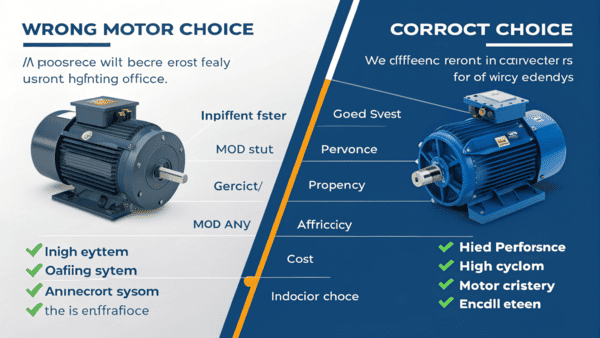

Choosing the wrong motor can be costly and inefficient. This mistake can lead to poor performance, high energy bills, and even system failures, but understanding the differences makes it easy.
Synchronous motors are best for applications needing precise, constant speed, like robotics. Asynchronous motors are rugged, cost-effective workhorses ideal for general-purpose uses like pumps and fans, where speed can vary slightly with the load. The choice depends entirely on your specific needs.
Now that you have a basic idea, you are probably wondering what really sets them apart. We need to look closer at the details to help you pick the perfect motor. Let's dive in and make sure you have all the facts to make a confident decision.
How do their working principles fundamentally differ?
Confused by motor mechanics? This complexity can make choosing the right one feel impossible. We'll simplify the core principles so you can understand what is happening inside the motor.
Synchronous motors have a rotor that magnetically locks with the stator's rotating field, ensuring constant speed. Asynchronous motors use induction, where the rotor 'slips' and rotates slightly slower than the field, making them simpler but with variable speed.
To really get it, we need to break down how each one works. I have been building motors for over 35 years, and the magic is all in how the rotor interacts with the stator. It is a simple but important difference.
The Synchronous Motor in Action
A synchronous motor works like a dance where both partners move in perfect time. The stationary part, the stator, uses AC power to create a magnetic field that rotates at a fixed speed. We call this the synchronous speed. The moving part, the rotor, is either a permanent magnet or an electromagnet powered by a separate DC source. When the motor starts, the magnetic poles on the rotor lock onto the rotating poles of the stator. They are pulled along together at the exact same speed. This "magnetic lock" is key. It means the motor's speed never changes, even if the load it is driving gets heavier or lighter, as long as it is within the motor's designed capacity. However, this motor cannot start on its own; it needs a special starting mechanism to get the rotor up to speed before the lock can happen.
The Asynchronous (Induction) Motor at Work
The asynchronous motor is the most common type of motor in the world for a reason: it is simple and reliable. It is also often called an induction motor. Like the synchronous motor, its stator creates a rotating magnetic field. But its rotor is different. It is usually a "squirrel cage" made of conductive bars. The magic happens through electromagnetic induction. As the stator's magnetic field rotates, it passes through the rotor bars, creating an electric current in them. This current generates the rotor's own magnetic field. The interaction between the stator's and rotor's magnetic fields creates the force that makes the rotor turn. For this to work, the rotor must always turn a little slower than the stator's field. This difference in speed is called "slip." Without slip, no current would be induced, and the motor would stop. This simple principle makes the motor self-starting and incredibly rugged.
What are the key performance and design differences?
Choosing a motor based on performance specs can be overwhelming. A wrong choice impacts your efficiency and your budget. Let's compare the critical differences side-by-side to make your decision clear.
Key differences lie in speed control, efficiency, and cost. Synchronous motors offer constant speed and higher efficiency but are more complex and expensive. Asynchronous motors are cheaper and more rugged, but their speed changes with the load and they have a lower power factor.
Over my career, I have helped thousands of customers weigh these differences. We always come back to a few core trade-offs. It is important to see them laid out clearly to understand which features matter most for your project.
A Head-to-Head Comparison Table
Let's put everything in a simple table. This makes it easy to see the main differences at a glance.
| Feature | Synchronous Motor | Asynchronous (Induction) Motor |
|---|---|---|
| Speed | Constant, locked to supply frequency (synchronous) | Varies with load, always less than synchronous |
| Rotor Construction | Wound with DC excitation or permanent magnets | Squirrel cage or wound rotor |
| Starting | Not self-starting; needs an external method | Self-starting |
| Power Factor | Can be controlled (leading, lagging, or unity) | Always lagging |
| Efficiency | Generally higher, especially in large sizes | Slightly lower, with losses due to slip |
| Cost | Higher initial cost and more complex | Lower initial cost and simpler construction |
| Maintenance | More maintenance due to brushes and slip rings | Very low maintenance, especially squirrel cage type |
| Applications | Precision control, timing, power factor correction | General purpose: pumps, fans, conveyors, appliances |
Deeper Look at Efficiency and Power Factor
Two of the most important factors are efficiency and power factor. Synchronous motors are often more efficient because there are no energy losses in the rotor from induction. All the energy goes directly into creating torque at a constant speed. This is especially true for very large motors used in heavy industry.
Power factor is a measure of how effectively electrical power is being used. A low power factor means you are wasting energy. Asynchronous motors naturally have a lagging power factor. Synchronous motors are special because you can adjust their power factor. By changing the DC power to the rotor, you can make them run at a perfect unity power factor or even a leading power factor. This can be used to cancel out the poor power factor from other equipment in a factory, which can save a lot of money on electricity bills.
How do you choose the right motor for your application?
Are you worried about making a costly mistake on your motor choice? The wrong motor can cause production delays and high energy bills. Here is a simple guide to match the motor to your job.
For precision tasks requiring constant speed like robotics or high-end machinery, choose a synchronous motor. For general-purpose applications like fans, pumps, and conveyors where ruggedness and low cost are key, the asynchronous motor is the standard choice.
At our company, we specialize in building reliable and efficient motors. With 38 years of experience, we know that the best motor is the one that perfectly fits the task. Let's look at some real-world examples.
When to Use a Synchronous Motor
You should choose a synchronous motor when exact speed is critical. If the speed cannot change, even when the load does, this is your motor. I remember a client with a large factory floor. Their power company was penalizing them for a poor power factor. We replaced a few large induction motors with synchronous motors, which not only ran their equipment but also corrected the power factor, saving them thousands on their utility bills.
Common applications include:
- High-precision machine tools: CNC machines need perfect timing and speed to make accurate cuts.
- Robotics and automation: Robots require precise, repeatable movements, which a constant-speed motor provides.
- Timing devices: Any application that relies on the motor's speed for timing needs a synchronous motor.
- Large industrial fans and compressors: In very large sizes, their high efficiency and ability to correct power factor make them a smart economic choice.
When an Asynchronous Motor is the Best Fit
The asynchronous motor is the workhorse of the industry. It is the right choice for the vast majority of applications where perfect speed is not necessary and you need a reliable, low-cost solution. Its simple and rugged design means it can handle tough conditions with very little maintenance. Our company ships over 125,000 of these highly reliable motors every year to customers in the US and Japan. They value the long life and dependability that we build into every unit.
Common applications include:
- Pumps, fans, and blowers: In these applications, a small variation in speed with load is perfectly acceptable.
- Conveyor systems: The priority is moving materials reliably, not at a scientifically precise speed.
- Compressors: Most standard air compressors use these motors for their reliability.
- Household appliances: Your refrigerator, washing machine, and dryer almost certainly use an asynchronous motor.
Conclusion
The right motor depends on your needs for speed, efficiency, and cost. Understanding these key differences ensures you get the best performance and value for your specific application.